Simeón Navajo
La piel del tamborSimeón Navajo is a Seville deputy inspector and Lorenzo Quart’s practical, irreverent police contact. He helps Quart pursue the anonymous hacker Vísperas and investigate the deaths surrounding Nuestra Señora de las Lágrimas, but makes clear that his assistance is personal rather than officially backed: his superiors do not want complications with churches, priests, or Rome, and the earlier deaths have been ruled accidents. His mixture of procedural diligence, vivid eccentricity, and candid awareness of his limits makes him both an effective ally and a measure of how little the institutions around the church are willing to intervene.
Identity and Presence
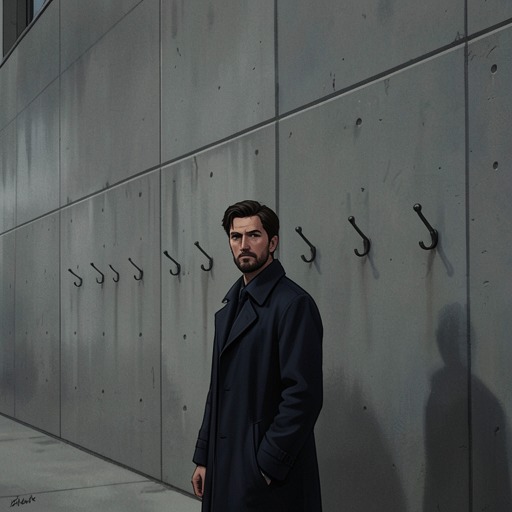
Navajo’s introduction places him in Casa Román, eating prawns and drinking beer while reporting the results of police inquiries. His appearance is distinctive: a slight, lean man with long hair tied back, round steel-framed glasses, a large moustache, and a loose floral shirt. Because his .357 Magnum makes an awkward bulge, he carries it in an embossed leather shoulder bag with fringe, described as having the look and smell of a poorly tanned camel-hide souk bag. The bag, the weapon, and the bright shirt set him sharply against Quart’s tall, thin, black-clad severity.
The comic physical details do not make him a comic investigator. He peels prawns with care, eats continuously, and speaks with an ease that contrasts with Quart’s reserve, yet he has access to police and telephone-security contacts and knows what their records can establish. His relaxed manner coexists with a clear grasp of jurisdiction: he can pass information and make calls, but cannot turn an informal favor into an official investigation without a concrete crime within his remit.
Investigating Vísperas
Navajo checks the people on Quart’s list against commercial suppliers and Telefónica. None appears to have bought advanced computer equipment under their own name and tax number. His inquiries also establish that Vísperas is not unique in secretly entering telephone networks to connect abroad, including to the Vatican; other hackers do the same, with some caught and others not. Navajo describes the particular hacker as difficult to trace, using loops and programs that erase traces and confuse detection systems.
The wider investigation shows why identifying Vísperas is difficult. The Vatican team has constructed “Sadducean Traps,” computer decoys arranged to confuse intruders or expose information useful for identification. One such trap lies on the route to the Pope’s personal terminal: an outsider entering through INMAVAT unknowingly carries a hidden code toward VOIA. At the threshold, the code blocks access to the real destination and diverts the intruder to the false VOIATS terminal, where any message left in the belief that it has reached the Pope cannot cause damage. Navajo’s local inquiries supply part of the investigative picture, while the Vatican’s technical countermeasure demonstrates the more elaborate institutional response to the same intrusion.
His findings do not identify the hacker. The police have no useful antecedents for the person Quart is seeking, and Navajo’s contacts indicate that Vísperas can enter and leave the network while disguising the route. Later revelations identify Vísperas as Cruz Bruner, who learned about computer networks through an online contact called Mad Mike, also known as Viscount Valmont. She says that a Roman contact, Deus ex Machina, supplied clues to the Vatican system; she began exploring it six or seven months earlier, when the dispute over Nuestra Señora de las Lágrimas was especially serious and local church authorities were not listening to Father Ferro. These disclosures clarify the hacker’s identity and purpose, but they do not turn Navajo’s earlier inquiries into a successful identification: the digital trail was deliberately difficult to follow.
Police Cooperation and Its Limits
At Casa Román, Navajo tells Quart that his superiors have made their position plain: cooperation is possible unofficially, as a personal favor between the two men, but the police do not want to become entangled with churches, priests, or Rome. If a specific crime within his competence is committed, the situation would be different. For now, however, the deaths at the church have been classified as accidents by a judge, and a hacker in Seville bothering the Pope is not a matter that the department is eager to pursue.
Navajo’s candor gives Quart useful information without pretending that the police are conducting a committed inquiry. The arrangement is defined by both assistance and refusal: Navajo makes calls, checks records, and shares what he can, but openly acknowledges the boundary imposed by his bosses. His willingness to help is personal, and the qualification matters. The church deaths are not treated as a continuing criminal case merely because Quart suspects a deeper connection; without a formally recognized offense, the official machinery remains at a distance.
That boundary does not prevent Navajo from contributing to the investigation of Father Príamo Ferro’s past. When Quart follows a lead supplied by Honorato Bonafé, Navajo calls Inspector Feijoo in Madrid, who is responsible for art investigations. The resulting information supports the account that a fifteenth-century altarpiece missing from Cillas de Ansó was later sold through the Claymore auction house. Navajo’s assistance helps connect a church disciplinary file and the journalist’s information to a traceable sale, even as the case’s circumstances leave questions about how the story reached Bonafé.
At the Church and Bonafé’s Death
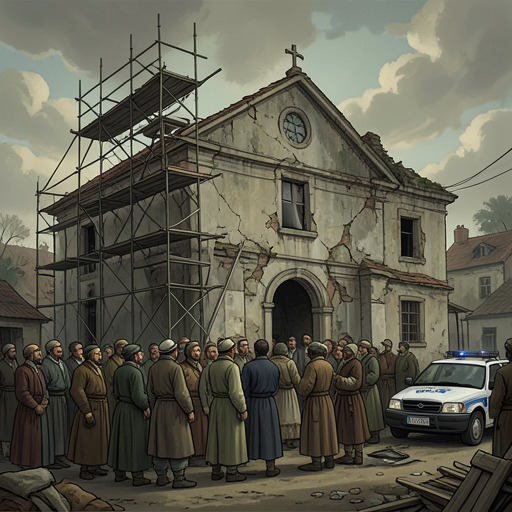
When Quart arrives at Nuestra Señora de las Lágrimas after another disaster, he finds police officers moving through the church, examining the floor, benches, and scaffolding. Navajo meets him in the central aisle, his familiar shoulder bag and bright red shirt conspicuous beneath the damaged stained glass and the baroque altar. He tells Quart, lightly, that the church has reached three deaths. The offhand tone turns their earlier talk about the church’s apparent mortality into a grim count; behind Navajo, a pair of motionless feet protrude from the confessional.
The dead man is Honorato Bonafé, a well-known Seville journalist whom Quart recognizes. Navajo knows that Bonafé had been active around the area in recent days and asks whether Quart wants to see the body. He lifts the covering from the journalist, whose bruised face and internal injuries suggest a violent blow or a fall. The forensic doctor cannot yet explain how Bonafé entered the confessional, or whether someone put him there. Navajo’s careful presentation of what is known—and what is not—keeps the discovery from settling into an easy conclusion.
Navajo questions Quart about what he knows of Bonafé and about their encounters in the lobby of Hotel Doña María. Their conversation is repeatedly interrupted by calls to the police officer’s mobile phone. One confirms that Father Ferro is still missing: he had spent the night, as usual, in the dovecote at Casa del Postigo, then disappeared; the bed in the presbytery was found unmade. Navajo also reports that Father Lobato left by bus for his new parish late the previous day, a long journey involving possible connections, and that the police and Civil Guard are trying to locate him. Until the cause of Bonafé’s death is established, Navajo says, nobody is officially a suspect—or, in another sense, everybody is.
Narrative Role
Navajo’s value to Quart lies in the combination of local access and institutional realism. He can make inquiries that cross from Seville’s police records to a Madrid art-investigation contact, and he can relay information from telephone security and police colleagues. Yet he does not possess the authority to make every suspicion actionable, nor does he conceal that his superiors would rather avoid the church affair. His character therefore keeps the investigation grounded in uneven cooperation: useful facts emerge through personal connections, while formal responsibility remains constrained by jurisdiction and institutional reluctance.
His manner also supplies a counterpoint to the novel’s religious and technological conflicts. The bagged revolver, the prawns, and the relaxed conversation belong to ordinary police work; the church’s repeated deaths, the missing priest, and the elusive hacker push that work into territory where ordinary explanations and official categories seem inadequate. Navajo does not resolve those tensions. Instead, he records their concrete consequences, follows leads when he can, and insists on the distinction between what is suspected and what can yet be proved.